

Australia Isn’t One Market: Beware of What National Coverage Really Means for Your Mobility Programme
For years, “national coverage” has been a reassuring phrase in corporate housing.
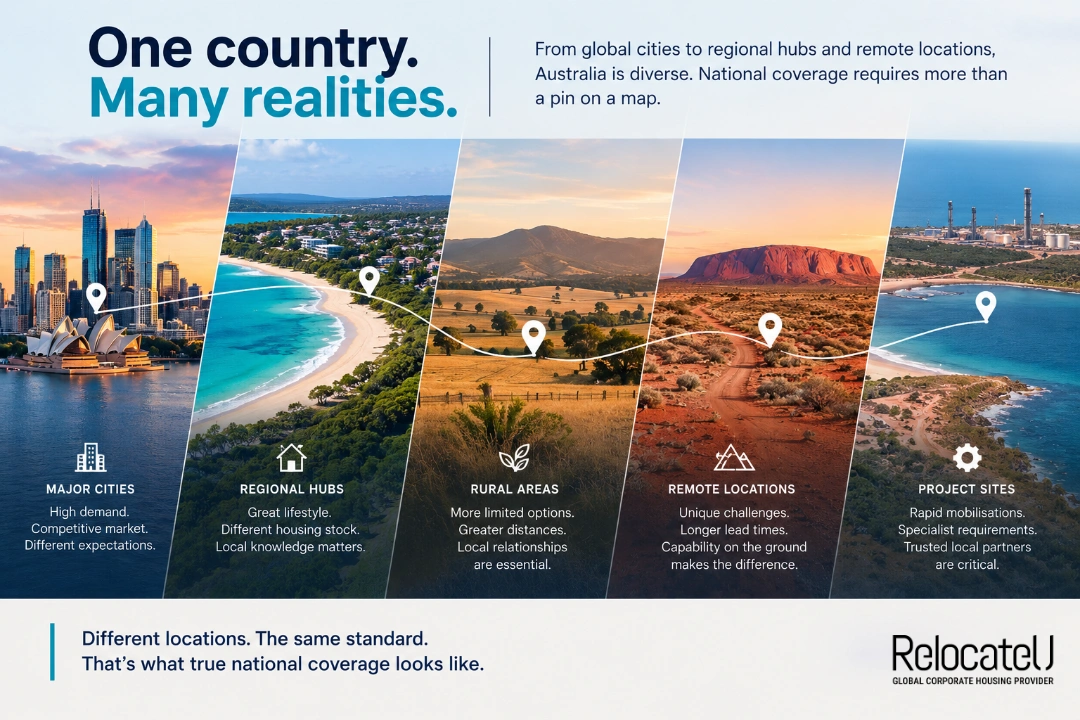
A provider has suppliers in Sydney, Melbourne, Brisbane and Perth. Perhaps a few more in Adelaide, Canberra or the Gold Coast. Put those locations on a map, and the country appears covered.
But Australia has a way of exposing the gap between coverage on a map and capability on the ground.
Sydney is not Perth. Perth is not Darwin. A remote project location is not a smaller version of Melbourne. And rural or remote locations cannot be supported using the same assumptions, suppliers or processes as a major city.
For global mobility teams, that distinction matters.
The Postcode Changes Everything
In many relocation markets, moving an employee from one city to another primarily changes the property search.
In Australia, the location can change the entire operating model.
The available housing stock can look completely different. Supplier relationships change. Travel distances increase. Local knowledge becomes more important. What is considered a convenient commute in one location may be entirely impractical in another.
And in some regional and remote markets, the question is not simply:
“What accommodation is available?”
It is:
“Does it meet the same standards we expect anywhere else — in terms of duty of care, modernity, health and safety?”
A different postcode should not mean a different standard.
The challenge is ensuring those standards are maintained even when housing options are more limited, distances are greater and local conditions are very different.
It is particularly relevant for organisations supporting infrastructure, energy, engineering, agriculture and other project-based workforces, where employees may be deployed well beyond the traditional corporate hubs.
A national housing programme therefore cannot simply replicate a city-based model across the country.
It needs to understand each location through a hyper-local lens.
That means understanding the realities of the area, the available housing stock, local transport and accessibility, proximity to workplaces and essential services, local supplier relationships and the practical considerations that can affect an employee’s experience and safety.
Because national coverage only has value when local knowledge sits behind it.
Coverage Is Not Capability
There is an important distinction between geographic reach and local capability.
Geographic reach tells a mobility team that accommodation can theoretically be found somewhere in a particular location.
Local capability means understanding what is actually happening there.
- Which suppliers are reliable?
- Which properties are genuinely suitable for corporate stays?
- What does “close to the workplace” mean in that particular location?
- What happens when an employee arrives late?
- Who is accountable when something is not right?
- How quickly can an issue be resolved when the nearest major city is several hours away?
These are not questions a supplier map can answer.
They are questions that require relationships, local knowledge, operational processes and accountability.
That is the difference between having coverage and being able to deliver.
The Real Stress Test of National Coverage
Perhaps this is why Australia is such an interesting market for corporate housing.
It is relatively easy to demonstrate capability in the obvious locations.
The harder question is what happens when the assignment moves beyond them.
- Can the same level of attention be maintained when the employee is no longer arriving in a major CBD?
- Can a provider combine local knowledge with global processes?
- Can procurement remain simple without making the employee experience impersonal?
- Can duty of care remain meaningful when the location is remote?
- And, importantly, is there a real person who owns the outcome when something goes wrong?
These are increasingly important questions as mobility programmes become more diverse and workforce deployment becomes less concentrated around traditional business centres.
Why This Matters to Global Mobility Teams
This becomes particularly important when Australia sits within a wider APAC mobility programme.
A mobility manager may be managing assignments across Singapore, Hong Kong, Australia, Japan and beyond. They should not need to become an expert in the Australian accommodation market simply because one employee is being sent to a regional location.
Nor should procurement teams have to manage a collection of disconnected local suppliers simply to achieve national coverage.
The real value of a national partner is therefore not simply one invoice or one point of contact.
It is reducing the number of things the mobility team has to worry about.
- One accountable partner.
- One set of service expectations.
- One operational framework.
- Local relationships where they matter.
- And the ability to adapt when the location does not fit the standard playbook.
At RelocateU, our approach to Australia is built around this distinction.
Our Australian capability spans metropolitan, regional and remote locations, supported by local procurement, flexible housing solutions and local supplier relationships, within the same technology, processes and duty-of-care framework used across our wider network.
The objective is not to make every Australian relocation look the same. It is to make every relocation equally well supported and successful. Because national coverage should mean more than having a pin on a map. It should mean delivering with excellence when the map gets complicated. Australia is vast. Your mobility programme should not have to feel it.